Cestrum Site — Restoring the Land
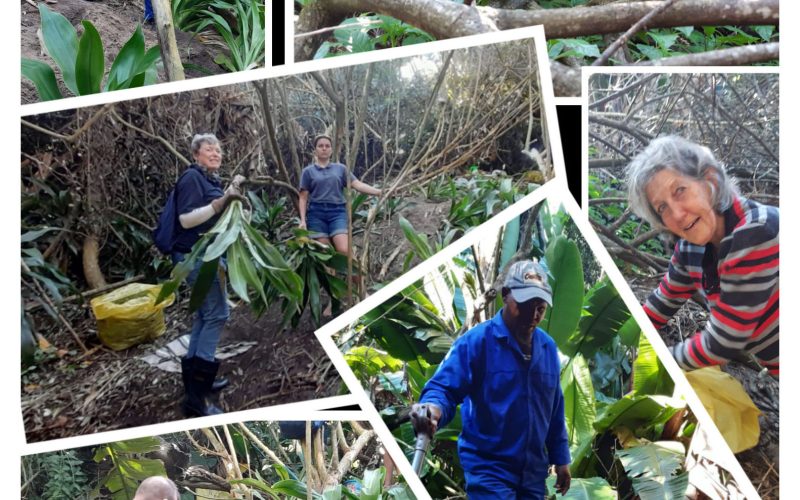
The battle against invasive alien plants in our coastal dune forests is often a slow, meticulous process. For the Leisure Bay Conservancy, one of our most rewarding restoration efforts has been the rehabilitation of the Cestrum site.
Stripping away aggressive invaders is only half the battle; the true healing begins when indigenous life is invited back to re-establish the balance of the natural ecosystem.
Preserving the understorey: Sarel’s guidance
When we first approached the cleared Cestrum site, a crucial question arose regarding how to manage the cleared ground without causing further disturbance to the soil. Following the invaluable advice of Leisure Bay resident Professor Sarel Cilliers, we chose a measured approach: leaving the existing understorey intact, regardless of whether the constituent plants were strictly indigenous or mixed, but ensuring that no alien invasive plants remained.
Sarel’s insight proved key. By keeping the understorey undisturbed, we protected the delicate soil structure from erosion, retained vital moisture, and provided a protective micro-climate for new growth. Rather than imposing a blank slate, we worked with the landscape, allowing the remaining vegetation to act as a nursery layer for the new plantings and newly emerging seedlings.
Restorative planting
With the framework of the site protected, we focused our efforts on reintroducing a robust selection of indigenous coastal plants designed to thrive in our specific regional conditions:
- Coastal Red Milkwoods (Mimusops caffra) — resilient coastal giants already establishing strong roots for future canopy and shade.
- Natal Guarri (Euclea natalensis) — large trees that thrive in the harsh conditions of the coastal dune forest.
- Coastal Silver-leaf (Brachylaena discolor) — tough against coastal winds, and taking hold well.
- Black Birdberry (Psychotria capensis) — adding diversity to the lower layers of the developing forest.
- Dragon plants (Dracaena aletriformis) — bringing structure and resilience to the recovering environment.
Coastal Red Milkwoods and Natal Guarri are the dominant large tree species in the South-East African coastal dune forests.
Natural regeneration
Perhaps the most exciting part of the Cestrum site’s recovery has been witnessing nature’s own resilience. Without direct human intervention, several vital species have begun to seed, sprout, and flourish on their own:
- Pigeonwood (Trema orientalis) — essential food for local bird life.
- Canary creeper (Senecio tamoides) — seasonal colour and climbing vigour.
- Coastal Double-Barrel Vine (Cyphostemma flaviflorum) — a sand-loving succulent climber that feeds birds and insects.
- Wild Banana (Strelitzia nicolai) — a striking subtropical presence in the recovering forest.
Looking forward
The transformation of the Cestrum site stands as a testament to patience, community dedication, and ecological mindfulness. By combining targeted indigenous plantings with a respectful approach to the understorey, we have watched a degraded space evolve into a vibrant, self-sustaining coastal sanctuary.