Cestrum Site — Our Most Ambitious Project
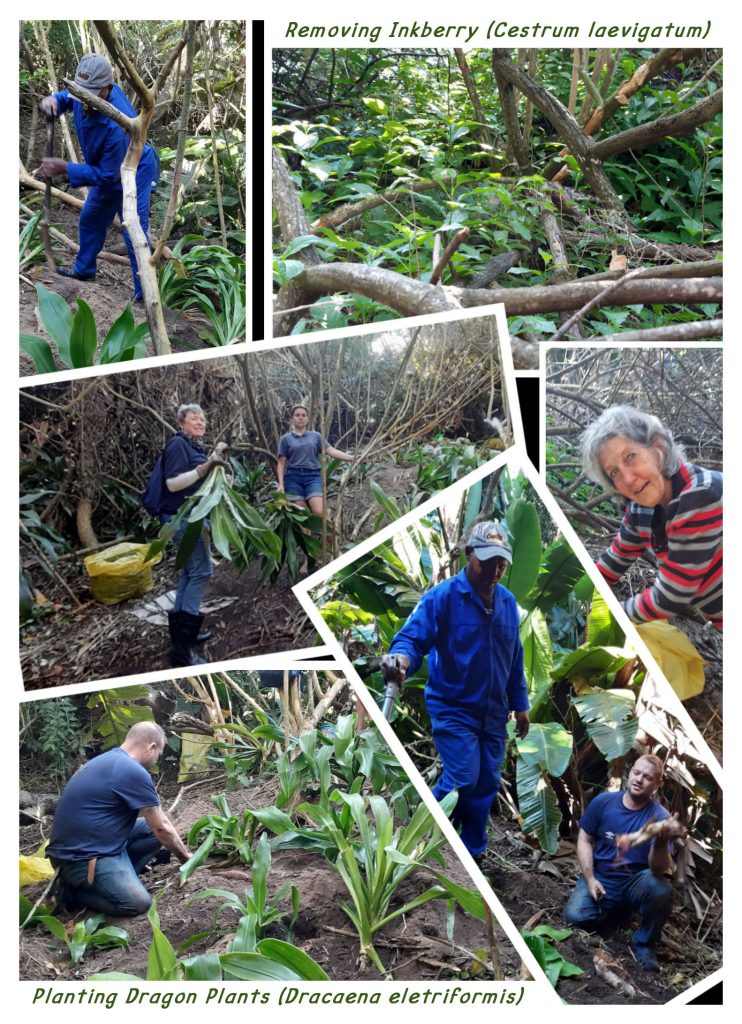
Over the past three years, the conservancy has undertaken its most ambitious environmental restoration challenge yet. Deep within the inner areas of the Admiralty Reserve’s coastal dune forest, a massive, hidden infestation had taken root, choking out indigenous vegetation and disrupting the natural balance of the habitat.
The area was heavily overrun by Inkberry (Cestrum laevigatum, a Category 1 alien invader plant), and our indigenous plants were struggling and hard to find. The Inkberry controlled the canopy, blocking out light from everything else.
Because of its concealed location, the extent of the infestation could not be seen from the nearby road or beach paths. It was discovered through satellite imagery of the region, which revealed the invasion of the coastal dune forest.
Discovery via satellite
Satellite imagery exposed what ground patrols missed, and our hearts sank as we took in the full extent of the problem. Apart from the sheer volume of trees that needed to be treated, the area consists of steep hills of loose soil, and low-slung branches which required gymnastics to navigate. This was no walk in the park.
Meet the troops
The extent of our paid workforce is two workmen who work twice a week, and a third who works once a week. We also have four volunteers, two of whom are over 70.
Our battle plan was to go in, taking one area at a time, and herbicide the cestrum. It was huge, but after a year we were beginning to see the results of our labour. Instead of working underneath the dark canopy, the trees started to die and the sun was breaking through.
The three-headed dragon
When we went back to the site, live branches were sprouting from dead trees and were starting to bear leaves and berries. Cestrum trees survive like a three-headed dragon. When one part is killed the other parts still live. If it is cut, it spreads its roots and grows again. And looking down, we were walking on a carpet of green. Seeds buried for years were now receiving sunlight — a carpet of cestrum.
Back in the trenches
The year was 2025 and we had to start again. Loose soil now covered in brittle fallen branches made it hard to walk.
Committee members, workmen and volunteers rose to the challenge, carefully painting gel herbicide on Cestrum plants too big to hand-pull, and sitting in the dirt, hand-pulling the seedlings. Extra labour was hired to help hand-pull in a massive manual eradication campaign.
Through sheer grit, physical endurance, and unwavering commitment, the team removed a staggering 650 bags, each weighing between 5kg and 8kg, of inkberry plants. This is not the end of it, because Cestrum laevigatum is a terribly resilient invader, so the area will have to be closely monitored over coming years, even decades.
Conservancy chairman Jenny Koen believes this to be “the most important conservation project that this Conservancy has ever embarked upon”.